What Happens to Beneficial Bacteria After Medication — And How to Rebuild
Kelly CookeWhat Happens to Beneficial Bacteria After Medication — And How to Rebuild
Treating sick koi is stressful enough without the secondary crisis that often follows: a crashed nitrogen cycle. Most pond keepers know that medications are necessary sometimes — parasites, bacterial infections, and fungal outbreaks can devastate a pond if left unchecked. What many pond keepers do not fully appreciate is the collateral damage that those same medications inflict on the beneficial bacteria responsible for keeping the water safe. Understanding this dynamic — and having a clear recovery protocol ready — can mean the difference between saving your fish and losing them to an ammonia spike days after you thought the treatment was over.
How Medications Affect Beneficial Bacteria
Beneficial bacteria — primarily species of Nitrosomonas and Nitrospira — are living organisms. They are susceptible to many of the same chemical agents used to treat fish diseases. The impact varies by medication, but very few treatments leave your biofilter completely unscathed.
Antibiotics
Antibiotics are designed to kill bacteria. They do not distinguish between the pathogenic bacteria making your fish sick and the nitrifying bacteria keeping your water chemistry stable. Broad-spectrum antibiotics like oxytetracycline, erythromycin, and amoxicillin are particularly damaging to biofilter populations. Even antibiotics that target gram-negative organisms can suppress nitrifying bacteria, which are gram-negative themselves. Expect significant to severe biofilter disruption after any antibiotic treatment course.
Formalin (Formaldehyde)
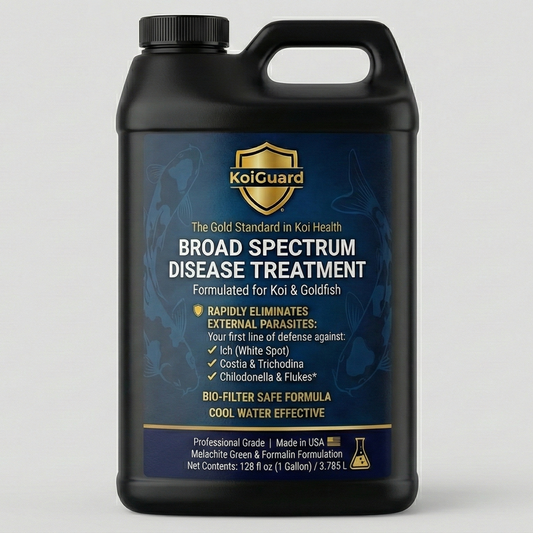
Formalin is widely used against parasites like ich, costia, and flukes. At treatment concentrations, it is toxic to all living cells to varying degrees, including beneficial bacteria. Short-term bath treatments cause less damage than prolonged pond-wide applications, but repeated formalin treatments over several days will measurably reduce your biofilter capacity.
Malachite Green
Often used in combination with formalin, malachite green is an antifungal and antiparasitic compound. It is a potent biocide that suppresses bacterial activity. When used at recommended concentrations it causes moderate biofilter disruption, but the cumulative effect of repeated applications can be severe.
Potassium Permanganate
Potassium permanganate is a powerful oxidizer used against bacteria, parasites, and organic matter. It is perhaps the most broadly destructive common pond treatment with respect to biofilter health. It oxidizes organic material indiscriminately, and the biofilm that beneficial bacteria live in is organic material. Multiple treatments, which are often necessary, compound the damage significantly.
Salt (Sodium Chloride)
Salt is one of the gentler treatment options when it comes to biofilter impact. At typical treatment levels of 0.3% to 0.5%, salt does suppress nitrifying bacteria somewhat, but it generally does not cause a full crash. At higher concentrations — above 0.6% — the impact becomes more pronounced. Salt treatments are often the least disruptive option when a medication choice exists.
Copper-Based Treatments
Copper sulfate and chelated copper products used for algae and some parasites are toxic to nitrifying bacteria at treatment concentrations. Copper persists in the system and can continue to suppress bacterial recovery even after the treatment period ends, making it one of the more challenging medications to recover from.
The Timeline of a Post-Medication Nitrogen Cycle Crash
Understanding the timeline is critical because the danger is not immediate. The water quality crisis typically arrives 3 to 7 days after the treatment ends, precisely when most pond keepers assume the worst is over and stop paying close attention.
Here is what happens:
- Day 0: Treatment ends. The medication has done its job. Your fish may be showing signs of recovery from whatever ailment you treated. Water parameters might still look acceptable because residual bacterial activity is handling the current ammonia load — barely.
- Days 1-3: Silent decline. The surviving bacteria are unable to multiply fast enough to maintain processing capacity. Ammonia begins to accumulate, but levels may still test within a tolerable range. Nothing looks wrong yet.
- Days 3-7: The spike. Ammonia rises to detectable and then dangerous levels. If you are not testing daily, this is where fish start showing stress symptoms — clamped fins, flashing, lethargy, loss of appetite, gasping at the surface. Nitrite often follows 2 to 4 days behind the ammonia spike, creating a second wave of toxicity.
- Days 7-14: Prolonged risk. Without intervention, the pond is now in a full nitrogen cycle crash. Ammonia and nitrite may fluctuate as the decimated bacterial population struggles to recover. Fish are under sustained physiological stress, and secondary infections become a real concern — especially in koi whose immune systems were already compromised by the original illness.
The cruel irony is unmistakable: you medicate to save your fish, and then the medication's secondary effects create a new life-threatening situation. This is why the post-medication recovery period is one of the most critical moments for water quality in the life of any pond.
The Recovery Protocol: Step by Step
Follow this protocol after completing any medication course. Do not skip steps, and do not assume your biofilter survived intact just because the water looks clear.
Step 1: Wait Until Medication Has Fully Dissipated
Do not add beneficial bacteria while active medication is still in the water — the medication will simply kill the new bacteria as well. Most treatments break down naturally over 24 to 72 hours, though this varies by product. Check the medication's label for guidance on its active duration. Some treatments, particularly copper-based products, require activated carbon filtration to remove residual compounds. Potassium permanganate turns the water progressively lighter as it oxidizes; when the water is clear or pale yellow, the treatment has been consumed.
Step 2: Perform a Partial Water Change
Once the medication has dissipated, do a 25-30% water change with dechlorinated water. This serves two purposes: it dilutes any residual medication metabolites that might still suppress bacteria, and it reduces whatever ammonia has already begun to accumulate. Do not do a massive water change — you want to dilute, not strip the pond of what little biological activity remains.
Step 3: Dose Bacteria at the Day 1 Loading Rate
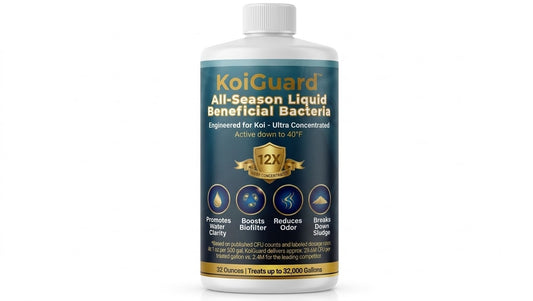
This is not the time for a maintenance dose. Treat the pond as if you are cycling it from scratch. For KoiGuard Pond Beneficial Bacteria, that means the full Day 1 loading dose: 8 fl oz of liquid (or 4 scoops of dry formula) per 1,000 gallons. You are essentially re-inoculating the system, and the higher initial concentration gives bacteria the best chance of establishing colonies quickly enough to handle the ammonia load your fish are producing.
Step 4: Turn Off UV Sterilization for 24 Hours
This step is non-negotiable. UV clarifiers work by exposing waterborne microorganisms to ultraviolet radiation as water passes through the unit. They are extremely effective at killing free-floating bacteria — which is exactly what your newly dosed beneficial bacteria are until they settle onto surfaces and begin forming colonies. Turn off the UV unit for a minimum of 24 hours after each bacterial dose to give the organisms time to attach to filter media, rocks, and other surfaces where they will be protected from UV exposure during normal circulation.
Step 5: Monitor Ammonia and Nitrite Daily
Daily testing is not optional during this period. Use a liquid test kit (not strips, which lack the precision needed at critical thresholds) to measure ammonia and nitrite every day. Your targets are:
- Ammonia: Below 0.25 ppm is manageable. Above 0.5 ppm requires a partial water change.
- Nitrite: Below 0.25 ppm is manageable. Above 0.5 ppm requires a partial water change.
If either parameter spikes above these thresholds, perform a 15-20% water change immediately to bring levels down, then re-dose bacteria. Continue daily testing until both ammonia and nitrite hold at zero for at least three consecutive days.
Step 6: Reduce Feeding
Reduce feeding to 50% of normal volume, or less if ammonia levels are persistently elevated. Every gram of food your fish consume becomes ammonia within hours. In a pond with compromised biological filtration, even normal feeding levels can overwhelm the system. Your fish are likely still recovering from their illness and may have reduced appetites anyway. Less food in means less ammonia out — it is the simplest way to reduce the load on your struggling biofilter.
Step 7: Maximize Aeration
Nitrifying bacteria require dissolved oxygen to function. So do stressed fish. Run every air pump and diffuser you have at maximum output. If you have a waterfall or venturi, make sure it is operating. High dissolved oxygen levels support faster bacterial recovery, reduce the toxic impact of ammonia on fish gills, and improve overall resilience during this vulnerable period.
Step 8: Re-Dose Bacteria Weekly
After the initial loading dose, continue dosing at the weekly maintenance rate — 4 fl oz liquid or 2 scoops dry per 1,000 gallons — until your nitrogen cycle is fully re-established. You will know the cycle has recovered when ammonia and nitrite both test at zero consistently, even at normal feeding levels. This typically takes 2 to 4 weeks depending on water temperature, fish load, and how severely the medication damaged the original bacterial population.
Water Temperature and Recovery Speed
Beneficial bacteria are temperature-dependent organisms. Their metabolic rate — and therefore their reproduction rate — is directly influenced by water temperature. Recovery at 75-85°F will be noticeably faster than recovery at 55°F. Below 50°F, bacterial reproduction slows dramatically, and cycle recovery can take significantly longer.
This presents a particular challenge during spring and fall treatments, when water temperatures may hover in the lower ranges. If you are treating fish in cooler water, plan for an extended recovery period and be especially diligent with daily testing. You may need additional rounds of bacterial dosing before the cycle fully stabilizes.
For more detail on how water temperature influences bacterial performance, see the KoiGuard Science page.
What If You Need to Medicate Again?
Sometimes a single treatment course is not enough. Parasites may require multiple rounds. A bacterial infection might relapse. If you need to re-treat, be aware that each successive medication round further depletes your biofilter. The recovery protocol remains the same, but expect longer recovery times and higher peak ammonia and nitrite levels with each round.
To manage this:
- Test water quality between treatment rounds. If ammonia or nitrite is already elevated before the next treatment, do a partial water change first.
- Consider a hospital tank. Treating fish in a separate hospital tank allows your main pond's biofilter to remain intact. This is the gold standard approach when feasible, particularly for individual fish that need extended treatment.
- Choose the gentlest effective medication. If salt will treat the condition, prefer it over potassium permanganate. Minimize collateral damage where treatment options allow.
Building a Post-Medication Kit
Since this situation is predictable — you know the biofilter will take a hit every time you medicate — it makes sense to be prepared before you start treatment. Have the following on hand before you dose the first round of medication:
- Concentrated beneficial bacteria. Enough for a full Day 1 loading dose plus at least 3 weeks of maintenance doses.
- A reliable liquid test kit for ammonia and nitrite (and ideally nitrate and pH as well).
- Dechlorinator for the partial water changes you will likely need.
- Activated carbon if you are using medications that need to be chemically removed (copper, some antibiotics).
Having these supplies ready means you can transition from treatment mode to recovery mode without delay. The KoiGuard FAQ page covers common dosing questions if you are uncertain about amounts for your specific pond size.
The Bigger Picture: Treatment and Recovery Are One Process
Too many pond keepers think of medication as the treatment and everything after as "getting back to normal." In reality, the treatment is not finished until the nitrogen cycle has fully recovered. A fish that survives ich treatment only to be subjected to a week of elevated ammonia has not been successfully treated — it has been subjected to two stressors in sequence, and the second one can be just as lethal as the first.
When you plan a medication course, plan the recovery alongside it. Budget the time. Buy the supplies. Schedule the daily testing. Treat the biofilter crash not as an unexpected complication but as an anticipated phase of the treatment process itself.
The Bottom Line
Most pond medications — including antibiotics, formalin, malachite green, potassium permanganate, and copper — kill or suppress the beneficial bacteria that drive your pond's nitrogen cycle. The resulting ammonia and nitrite spikes typically arrive 3 to 7 days after treatment ends, precisely when attention tends to wane. The recovery protocol is clear: wait for medication to dissipate, perform a partial water change, dose beneficial bacteria at the full Day 1 loading rate, turn off UV for 24 hours, monitor ammonia and nitrite daily, reduce feeding, maximize aeration, and re-dose bacteria weekly until both parameters hold steady at zero. This is one of the most critical water quality moments your pond will face. Prepare for it before you medicate, execute the protocol methodically afterward, and you will bring your fish — and your pond's biology — through safely.