What Causes Ammonia and Nitrite Spikes in Koi Ponds — And How to Fix Them Fast
Kelly CookeWhat Causes Ammonia and Nitrite Spikes in Koi Ponds — And How to Fix Them Fast
Few things send a koi keeper's heart rate up faster than pulling a water test and seeing ammonia or nitrite levels in the danger zone. These spikes are one of the most common — and most urgent — problems in koi ponds, and they can go from "slightly elevated" to "fish are in serious trouble" within hours. Understanding why they happen, recognizing the warning signs, and knowing exactly how to respond can mean the difference between a temporary setback and a devastating loss.
This guide breaks down the nitrogen cycle in plain terms, explains every major cause of ammonia and nitrite spikes, tells you exactly what to do when levels are high, and lays out a prevention strategy so you rarely face this emergency again.
The Nitrogen Cycle: A Quick Refresher
Every koi pond is a living ecosystem, and at the center of that ecosystem is the nitrogen cycle — the biological process that converts toxic fish waste into progressively less harmful compounds. Here is how it works in three steps:
- Step 1 — Ammonia (NH3/NH4+): Your koi produce ammonia constantly through their gills, urine, and waste. Uneaten food and decaying organic matter also release ammonia. In its un-ionized form (NH3), ammonia is highly toxic to fish even at low concentrations.
- Step 2 — Nitrite (NO2-): A group of beneficial bacteria called Nitrosomonas consume ammonia and convert it to nitrite. While this is progress, nitrite is still very toxic to koi. It enters the bloodstream through the gills and interferes with the blood's ability to carry oxygen — a condition sometimes called "brown blood disease."
- Step 3 — Nitrate (NO3-): A second group of beneficial bacteria called Nitrobacter convert nitrite into nitrate, which is far less toxic and is easily managed through partial water changes and plant uptake.
When this cycle is running smoothly, ammonia and nitrite levels stay at or near zero. A spike in either one means the cycle has been disrupted — the bacteria responsible for conversion are either absent, insufficient, or overwhelmed.
What Causes Ammonia and Nitrite Spikes
Spikes do not happen randomly. There is always a cause, and identifying it is the first step toward fixing the problem and preventing it from recurring.
New Pond Syndrome (Cycling)
The single most common cause of ammonia and nitrite spikes is a pond that has not yet established a mature nitrogen cycle. When you fill a new pond and add fish, ammonia begins accumulating immediately, but the beneficial bacteria that process it take weeks to establish in sufficient numbers. You will typically see ammonia peak first, followed by a nitrite peak as the first bacterial group establishes but the second has not yet caught up. This is normal — but it is also dangerous if you are not managing it actively.
Overfeeding
Every gram of food that enters your pond becomes part of the nitrogen load. Uneaten food decays on the bottom and releases ammonia directly. Even food that is eaten produces ammonia through normal fish metabolism. Feeding more than your koi can consume in five minutes, or feeding too frequently, is one of the fastest ways to overwhelm your biological filtration.
Overstocking
More fish means more ammonia production. A filter system that comfortably handles six koi may be completely overwhelmed by twelve. If you have recently added new fish to your pond, the existing bacterial population may not be large enough to handle the increased waste load, resulting in a spike while the biology catches up.
Filter Cleaning Done Wrong
Your biological filter media is home to the vast majority of your pond's beneficial bacteria. When you clean filter pads and media with chlorinated tap water, or replace all your media at once, you can wipe out a significant portion of your bacterial colony in one afternoon. Always clean filter media with pond water, and if you need to replace media, do it in stages — never all at once.
Medication and Chemical Treatments
Many pond medications, particularly antibiotics and anti-parasitic treatments, do not distinguish between harmful and beneficial bacteria. A course of antibiotics can decimate your nitrifying bacteria, causing ammonia and nitrite to spike days after treatment begins. This is one reason experienced koi keepers always plan to re-dose beneficial bacteria after any medication cycle.
Dead Fish or Large Organic Debris
A fish that dies unnoticed in a pond — perhaps hidden among rocks or plants — can release a significant ammonia load as it decomposes. The same applies to large quantities of leaves, uneaten food accumulation, or other organic matter that breaks down suddenly.
Hot Weather and High Metabolism
When water temperatures rise in summer, your koi's metabolism accelerates. They eat more, produce more waste, and consume more oxygen. At the same time, warmer water holds less dissolved oxygen, which can stress the aerobic bacteria responsible for nitrification. The combination of higher ammonia production and potentially reduced bacterial efficiency makes summer a prime time for spikes, particularly in ponds that are stocked near capacity.
Power Outages and Equipment Failure
Beneficial bacteria in your filter require oxygenated water flowing through the media to survive. A pump failure or extended power outage can kill off filter bacteria within hours, especially in warm weather. When flow resumes, you may face an ammonia spike because your biological filtration has been significantly reduced.
Recognizing the Warning Signs in Your Koi
Your koi will often tell you something is wrong before your test kit does — if you know what to look for. These are the behavioral and physical symptoms associated with ammonia and nitrite toxicity:
- Gasping at the surface: Koi hovering near the surface or around waterfall returns are trying to access higher-oxygen water. This is one of the earliest and most visible signs of both ammonia and nitrite stress.
- Flashing and scratching: Koi rubbing against rocks, the pond bottom, or walls may be reacting to gill irritation caused by ammonia. This behavior is often mistaken for parasites.
- Lethargy and loss of appetite: Fish that are normally active and eager to feed become listless and refuse food. They may sit on the bottom or isolate themselves from the group.
- Red streaks on fins and body: Ammonia burns cause visible inflammation, often appearing as red streaking in the fins, around the gills, or on the belly. This is a sign of tissue damage and indicates prolonged exposure.
- Clamped fins: Fins held tight against the body rather than spread naturally indicate general stress and discomfort.
- Dark or brownish gills: Nitrite poisoning specifically affects the gills, turning them from a healthy red to a brownish color as the blood's oxygen-carrying capacity is compromised.
If you observe any combination of these symptoms, test your water immediately. Do not wait to see if things improve on their own.
Emergency Response: What to Do Right Now
When your test results confirm elevated ammonia (above 0.25 ppm) or nitrite (above 0.25 ppm), take these steps immediately and in this order:
Step 1: Stop Feeding
Every meal your koi eat adds to the ammonia load. Stop feeding completely until levels return to safe ranges. Healthy koi can go days or even weeks without food — the temporary hunger is far less dangerous than continued ammonia or nitrite exposure.
Step 2: Perform a Partial Water Change
A water change is the single fastest way to reduce the concentration of ammonia or nitrite in your pond. Change 25 to 50 percent of your water, using dechlorinated water that is close to your pond's current temperature. If levels are critically high (ammonia above 1.0 ppm or nitrite above 1.0 ppm), a 50 percent change is warranted. You may need to perform additional water changes over the following days if levels remain elevated.
Important: Always dechlorinate replacement water. Chlorine and chloramine in tap water will kill the very bacteria you are trying to establish.
Step 3: Add Beneficial Bacteria at Loading Dose
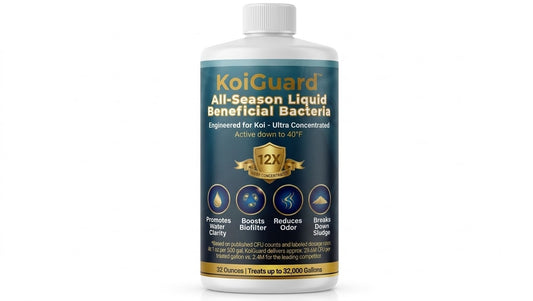
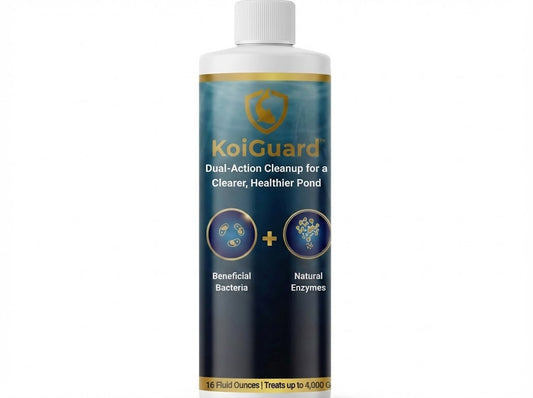
This is where the real fix begins. Apply KoiGuard Pond Beneficial Bacteria at the Day 1 loading dose — 8 fl oz per 1,000 gallons for liquid, or 4 scoops per 1,000 gallons for dry. You are not just supplementing — you are aggressively re-establishing the bacterial population that processes these toxins. Turn off your UV sterilizer for 24 hours to give the bacteria time to colonize without being destroyed.
Step 4: Maximize Aeration
Both nitrifying bacteria and stressed koi need oxygen. Turn on any additional air pumps, point waterfall returns to maximize surface agitation, and if you have a venturi fitting, open it up. More oxygen supports bacterial activity and helps your fish cope with the physiological stress of toxin exposure.
Step 5: Test Again in 12 to 24 Hours
Monitor levels closely. You should see ammonia and nitrite begin to decrease within 24 to 48 hours if your bacterial supplementation and water changes are working. Continue daily testing until levels are consistently at zero. Resume feeding gradually — small amounts once daily — only after levels have been stable for at least 48 hours.
Why Beneficial Bacteria Are the Only Real Fix
Walk into any pond supply store and you will find chemical products that claim to "neutralize" or "detoxify" ammonia. These products work by chemically binding ammonia into a less toxic form (ammonium). They are useful as a temporary emergency measure, but they have a critical limitation: they do not remove ammonia from the system. They simply change its form. The bound ammonia is still there, and when the chemical wears off, it can become toxic again.
Beneficial bacteria, by contrast, actually consume ammonia and convert it into nitrite, and then nitrate. They remove it from the system permanently. This is the only sustainable solution to ammonia and nitrite problems. Chemical binders buy you time. Bacteria solve the problem.
This is why consistent dosing with a high-quality bacterial product matters so much. When your pond has a robust, well-established population of nitrifying bacteria, it can handle the daily ammonia load your fish produce, absorb temporary spikes from overfeeding or hot weather, and recover quickly from disruptions. To understand more about the science behind how these bacterial strains work, visit the KoiGuard Science page.
Acceptable Water Quality Levels
Knowing what your test results should look like is just as important as knowing what to do when they are wrong. Here are the target ranges for a healthy koi pond:
- Ammonia (NH3/NH4+): 0 ppm. Any detectable ammonia is a concern. Above 0.25 ppm requires action. Above 1.0 ppm is an emergency.
- Nitrite (NO2-): 0 ppm. Same thresholds as ammonia — above 0.25 ppm, take action; above 1.0 ppm, act immediately.
- Nitrate (NO3-): Below 40 ppm. Nitrate is far less toxic but should be kept in check through regular partial water changes.
- pH: 7.0 to 8.5. Note that ammonia is significantly more toxic at higher pH levels. A pond with a pH of 8.5 and an ammonia reading of 0.5 ppm is a much more dangerous situation than the same ammonia level at pH 7.0.
Invest in a reliable liquid-based test kit (not test strips, which are less accurate) and test at least weekly during the active season. During a spike or any time you notice behavioral changes in your fish, test daily.
Prevention: Keeping Spikes from Happening
The best emergency is the one that never happens. Here is how to maintain the stable nitrogen cycle that keeps ammonia and nitrite at zero:
Dose Bacteria Consistently
Weekly dosing with KoiGuard Beneficial Bacteria at 4 fl oz per 1,000 gallons (liquid) or 2 scoops per 1,000 gallons (dry) continuously replenishes your bacterial population. This is especially important during peak season when waste production is highest, but it matters year-round in any pond with water temperatures above 50 degrees Fahrenheit.
Do Not Over-Clean Your Filters
Clean biological filter media only when flow is noticeably reduced, and always rinse with pond water — never tap water. Leave some "grime" on the media. That biofilm is your bacterial colony, and it is doing exactly what you want it to do. If you must replace media, do it one section at a time over several weeks.
Feed Appropriately
Feed only what your koi can consume in about five minutes, and remove any uneaten food. Adjust feeding frequency and quantity based on water temperature — koi metabolism slows significantly below 60 degrees Fahrenheit and essentially stops below 50 degrees.
Stock Responsibly
A common guideline is one inch of fish per ten gallons of water, but for koi — which grow large and produce substantial waste — more conservative stocking allows your biological filtration to keep up without strain. When adding new fish, introduce them gradually and consider a loading dose of bacteria to help the system adjust.
Plan Around Disruptions
If you know you are about to do something that will impact your biological filter — like a medication treatment, a filter overhaul, or a large water change — dose bacteria before and after. A proactive loading dose before a disruption can significantly reduce the severity and duration of any resulting spike. Check our FAQ page for specific guidance on dosing around medications and treatments.
Monitoring: Your Best Defense
Regular water testing is the foundation of spike prevention. Many ammonia and nitrite spikes are caught early — before fish show symptoms — by pond owners who test on a consistent schedule. Here is a practical monitoring approach:
- Weekly testing during the active season (spring through fall) for ammonia, nitrite, nitrate, and pH.
- Daily testing whenever you notice behavioral changes, after adding new fish, during and after medication, and during heat waves.
- Periodic testing during winter if you keep your pond running, focusing on ammonia since bacterial activity is reduced in cold water.
Keep a simple log of your test results. Trends are often more informative than individual readings. A gradual upward trend in ammonia over several weeks tells you that your biological filtration is falling behind before you hit crisis levels.
The Bottom Line
Ammonia and nitrite spikes are serious, but they are also solvable and preventable. The nitrogen cycle is your pond's life support system, and beneficial bacteria are what make it run. When a spike occurs, act fast: stop feeding, change water, dose bacteria aggressively, and maximize aeration. Then address the root cause — whether it is overfeeding, overstocking, filter damage, or simply a pond that needs a more consistent bacteria maintenance routine. With reliable weekly dosing, proper feeding habits, and regular water testing, most koi keepers find that spikes become a rare event rather than a recurring crisis. Prevention is always easier, cheaper, and less stressful — for both you and your fish.