Pond Volume Dosing Guide: How to Calculate and Dose Koi Treatments Correctly
Kelly CookePond Volume Dosing Guide: How to Calculate and Dose Koi Treatments Correctly
Every bottle of pond treatment you own has one thing in common: the instructions are based on your pond's volume. Get that number wrong, and everything downstream goes wrong with it. Underdose your beneficial bacteria, and you are essentially throwing money into the water without establishing the colonies your pond needs. Overdose, and you risk oxygen depletion, wasted product, or unnecessary stress on your fish. Accurate dosing is not a minor detail — it is the foundation of effective pond care.
This guide walks you through how to calculate your pond's volume with confidence, how to match that volume to the right product sizes, and exactly how much of each KoiGuard treatment to apply on Day 1 and every week after. Whether you have a simple rectangular pond or a complex multi-level design with waterfalls and streams, you will walk away knowing your numbers.
Why Accurate Dosing Matters More Than You Think
Pond treatments are formulated to work at specific concentrations. Beneficial bacteria need a certain population density to outcompete harmful organisms and effectively process ammonia and nitrite. Enzymes require adequate concentration to break down organic matter at a meaningful rate. When you miss the mark on dosing, one of two things happens:
- Underdosing: The treatment never reaches effective concentration. Bacteria colonies fail to establish, enzymes cannot keep up with organic load, and you see little to no improvement in water quality. Many pond owners who say "bacteria products don't work" are simply underdosing because they underestimated their pond's volume.
- Overdosing: While most biological treatments have a wide safety margin, significant overdosing wastes product and can temporarily reduce dissolved oxygen as large bacterial populations consume oxygen during rapid colonization. Your wallet suffers even if your fish do not.
The difference between a pond owner who swears by beneficial bacteria and one who dismisses them often comes down to whether they calculated their volume correctly in the first place.
How to Calculate Your Pond's Volume
All pond volume calculations follow the same basic principle: determine the volume in cubic feet, then multiply by 7.48 to convert to gallons. The method you use depends on your pond's shape.
Rectangular and Square Ponds
This is the simplest calculation. Measure your pond's length, width, and average depth in feet, then apply the formula:
Length (ft) x Width (ft) x Average Depth (ft) x 7.48 = Gallons
For example, a pond that is 10 feet long, 8 feet wide, and averages 3 feet deep:
10 x 8 x 3 x 7.48 = 1,795 gallons
Note the emphasis on average depth. Most ponds are not uniform — they have shallow edges and a deeper center. Measure the depth at several points and use the average for a more accurate result.
Circular Ponds
For round ponds, you need the radius (half the diameter) and average depth:
3.14 x Radius (ft) x Radius (ft) x Average Depth (ft) x 7.48 = Gallons
A circular pond with a 12-foot diameter (6-foot radius) and an average depth of 3 feet:
3.14 x 6 x 6 x 3 x 7.48 = 2,535 gallons
Oval Ponds
Treat an oval pond like a modified rectangle. Measure the longest dimension (length), the widest dimension (width), and average depth, then multiply by 0.8 to account for the rounded shape:
Length (ft) x Width (ft) x Average Depth (ft) x 7.48 x 0.8 = Gallons
Irregular Ponds
Most koi ponds are not perfect geometric shapes. For irregular ponds, the most reliable method is to break the pond into simpler shapes — rectangles, circles, or triangles — calculate each section separately, and add the volumes together. This "divide and conquer" approach gets you much closer to reality than trying to estimate one big number.
Alternatively, if you know your pond's surface area in square feet, simply multiply by the average depth and then by 7.48.
The Quick-Check Method
If math is not your favorite pastime, there is a shortcut. Time how long it takes to fill your pond with a garden hose. A typical garden hose delivers roughly 6 gallons per minute (though flow rates vary). Multiply the fill time in minutes by your hose's flow rate, and you have a volume estimate. This works best for smaller ponds and new builds where you can fill from empty.
For a faster and more precise approach, use KoiGuard's Pond Volume Calculator, which handles all the math for you and recommends the right product sizes for your result.
Special Considerations That Affect Volume
Your pond's "footprint" is only part of the picture. Several features commonly found in koi pond setups can significantly affect total water volume.
Waterfalls and Streams
A waterfall or stream channel holds water that is part of your system's total volume. For streams, measure the length, average width, and average depth, then calculate as you would a rectangular pond. A 15-foot stream that is 2 feet wide and 4 inches deep adds roughly 75 gallons — not a huge number, but it adds up when combined with other features.
External Filters and Plumbing
Bead filters, drum filters, settling chambers, and the plumbing that connects them all hold water. A large external filter system can easily add 50 to 200 gallons to your total volume. Check manufacturer specifications for your filter's water capacity.
Shelves and Ledges
Many ponds feature built-in shelves for marginal plants. These shallow areas reduce your volume compared to a simple depth calculation. If a significant portion of your pond's footprint is occupied by 12-inch-deep shelves rather than the full 3- or 4-foot depth, your actual volume may be 10 to 20 percent less than a basic calculation suggests.
When in Doubt, Round Up
If your calculation leaves you uncertain, it is better to slightly overestimate your volume than to underestimate it. A modest overdose of beneficial bacteria is far less problematic than a significant underdose.
Common Pond Sizes and Product Sizing Guide
To help you match your pond volume to the right KoiGuard product size, here is a quick reference for common pond dimensions and their approximate volumes:
- Small pond (6 x 4 x 2 ft): approximately 360 gallons
- Medium pond (10 x 8 x 3 ft): approximately 1,800 gallons
- Large pond (15 x 10 x 4 ft): approximately 4,500 gallons
- Extra-large pond (20 x 15 x 4 ft): approximately 9,000 gallons
Which Product Size Do You Need?
KoiGuard Pond Beneficial Bacteria is available in multiple formats to fit ponds of every size:
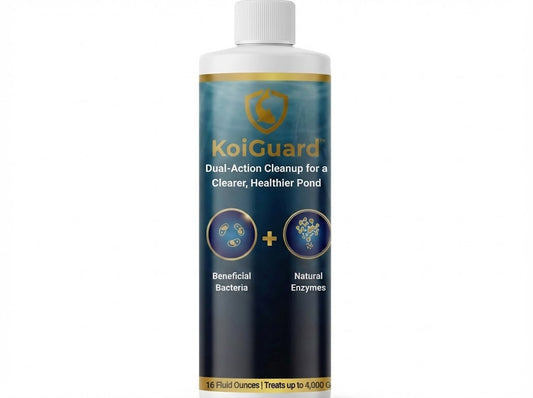
- Liquid 16 oz: Treats up to 4,000 gallons — ideal for small to medium ponds
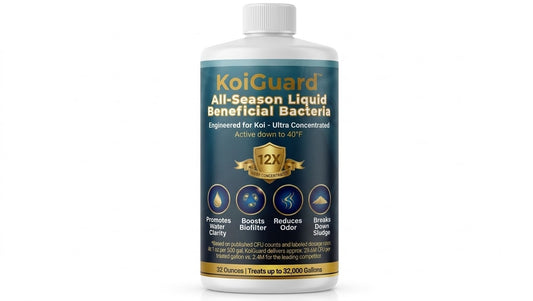
- Liquid 32 oz: Treats up to 16,000 gallons — covers most backyard koi ponds through a full dosing cycle
- Dry 1 lb: Treats up to 16,000 gallons — preferred by many experienced pond keepers for its shelf life and concentrated potency
KoiGuard Pond Enzymes are available in 16 oz, 32 oz, and 1-gallon sizes, with the gallon size treating up to 32,000 gallons.
For the simplest approach, KoiGuard BeneZyme combines bacteria and enzymes in a single product, available in 16 oz, 32 oz, and 1-gallon sizes.
Complete Dosing Tables
All KoiGuard products follow a two-phase dosing protocol: a higher initial dose on Day 1 to rapidly establish effective concentrations, followed by a lower weekly maintenance dose to sustain results.
Beneficial Bacteria — Liquid
- Day 1 (Loading Dose): 8 fl oz per 1,000 gallons
- Weekly Maintenance: 4 fl oz per 1,000 gallons
For a 2,000-gallon pond, that means 16 fl oz on Day 1 and 8 fl oz each week thereafter.
Beneficial Bacteria — Dry
- Day 1 (Loading Dose): 4 scoops per 1,000 gallons
- Weekly Maintenance: 2 scoops per 1,000 gallons
Pond Enzymes
- Day 1 (Loading Dose): 8 fl oz per 1,000 gallons
- Weekly Maintenance: 4 fl oz per 1,000 gallons
BeneZyme (2-in-1 Bacteria + Enzymes)
- Day 1 (Loading Dose): 8 fl oz per 1,000 gallons
- Weekly Maintenance: 4 fl oz per 1,000 gallons
Day 1 vs. Weekly Dosing: Why Both Matter
The Day 1 loading dose serves a specific biological purpose. When you first introduce beneficial bacteria to a pond — whether it is a new pond, a spring startup, or recovery from a water quality crisis — you need a large initial population to colonize filter media, pond surfaces, and the water column. Think of it as seeding a lawn: you spread seed densely to ensure full coverage, then overseed lightly to maintain it.
The weekly maintenance dose replenishes bacteria that are naturally lost through die-off, UV exposure, and competition. It also ensures that your bacterial population keeps pace with the organic load your fish produce. Skipping weekly doses is the most common reason pond owners experience a gradual decline in water clarity weeks after a promising start.
How to Apply KoiGuard Products
Proper application technique matters almost as much as dosing accuracy. Follow these steps for the best results:
- Dilute before applying. Mix your measured dose with a bucket of pond water. This helps distribute the product more evenly and prevents concentrated spots near the application point.
- Distribute evenly. Pour the diluted mixture around the perimeter of your pond rather than dumping it in one spot. If you have a waterfall or stream, pouring some of the mixture at the top allows the flow to carry it throughout the system.
- Turn off your UV sterilizer for 24 hours after applying bacteria products. UV light kills bacteria indiscriminately — including the beneficial strains you just added. Giving bacteria a 24-hour window to attach to surfaces and begin colonizing is critical for effectiveness. You can leave your UV running when applying enzyme-only products.
- Apply when water temperature is between 50 and 90 degrees Fahrenheit. Bacteria are living organisms, and their activity is temperature-dependent. Below 50 degrees, metabolism slows to the point where dosing offers minimal benefit. Above 90 degrees, dissolved oxygen may already be low, and adding large bacterial populations can further stress the system.
- Dose in the morning when possible. Dissolved oxygen levels are typically highest in the early part of the day, giving bacteria the best conditions to establish.
Sample Dosing Scenarios
To bring this all together, here are a few real-world examples:
Scenario 1: New 1,500-Gallon Pond
You just filled your pond and are beginning the cycling process. Using KoiGuard Liquid Beneficial Bacteria, your Day 1 dose is 12 fl oz (8 fl oz per 1,000 gallons x 1.5). Weekly, you will apply 6 fl oz. A single 16 oz bottle covers your Day 1 dose plus the first weekly dose, making the 32 oz size the better value for a full startup cycle.
Scenario 2: Established 5,000-Gallon Pond, Spring Startup
After winter dormancy, you are restarting your biological filtration. Your Day 1 dose of liquid bacteria is 40 fl oz (8 fl oz x 5), and your weekly dose is 20 fl oz. A 32 oz bottle gets you through Day 1 with a bit extra, but you will need additional product for ongoing weekly dosing. Pairing bacteria with enzymes during spring startup accelerates the breakdown of accumulated organic debris.
Scenario 3: 3,000-Gallon Pond Using BeneZyme
You prefer the simplicity of a combined product. Your Day 1 BeneZyme dose is 24 fl oz, and your weekly dose is 12 fl oz. The 32 oz BeneZyme covers Day 1, and a second bottle carries you through about two and a half weeks of maintenance. The 1-gallon size offers the best long-term value for a pond this size.
Frequently Asked Questions About Dosing
What if I do not know my exact pond volume?
Use the calculation methods above to get as close as possible, and round up slightly. Visit the KoiGuard Pond Calculator page for an interactive tool that simplifies the process. You can also check our FAQ page for more guidance.
Can I double-dose to speed up results?
The Day 1 loading dose is already a double dose relative to the weekly amount. Adding more beyond that rarely accelerates results and can temporarily lower dissolved oxygen. Stick with the protocol — it is designed to work within a predictable timeframe.
Should I dose differently if I have a heavy fish load?
Ponds with high stocking densities produce more ammonia and organic waste. While the standard dosing protocol handles most situations, heavily stocked ponds benefit from consistent weekly dosing without skipping weeks. If you are managing a high-load pond, consider adding Pond Enzymes alongside bacteria to handle the extra organic burden.
How long does a bottle last?
That depends on your pond volume and dosing frequency. A 32 oz bottle of liquid bacteria treats up to 16,000 gallons at the loading dose — so a 2,000-gallon pond gets a Day 1 dose and several weeks of maintenance from a single bottle. Refer to the dosing tables above to estimate how long each product size will last for your specific setup.
The Bottom Line
Accurate pond volume calculation is not optional — it is the first step in every successful treatment protocol. Take the time to measure your pond properly, account for features like waterfalls, streams, and shelves, and use the dosing tables in this guide to apply the right amount of product every time. Whether you choose KoiGuard Beneficial Bacteria, Pond Enzymes, or the all-in-one BeneZyme, correct dosing is what separates a product that works from one that disappoints. Start with your numbers, follow the protocol, and let the biology do the rest.