Liquid vs Dry Beneficial Bacteria: Which Formula Is Better for Your Koi Pond?
Kelly CookeLiquid vs Dry Beneficial Bacteria: Which Formula Is Better for Your Koi Pond?
When you decide to add beneficial bacteria to your koi pond — and you absolutely should — the next question is which form to use. Beneficial bacteria products come in two primary formats: liquid suspensions and dry powder or granular concentrates. Both contain the same fundamental organisms responsible for the nitrogen cycle. Both work. But they differ in formulation, handling, activation speed, shelf life, cost-per-dose, and practical convenience in ways that matter depending on your pond size, maintenance routine, and personal preferences.
This is not a question with a single correct answer. It is a question of which format suits your situation best. Here is an honest comparison.
How Liquid Beneficial Bacteria Is Formulated
Liquid beneficial bacteria products are aqueous suspensions containing live bacterial cultures — primarily Nitrosomonas and Nitrobacter species, along with heterotrophic bacteria that aid in organic waste decomposition. The bacteria are suspended in a stabilized liquid medium that keeps them viable and metabolically active (or in a state of reduced metabolic activity) within the bottle.
When you pour liquid bacteria into your pond or biofilter, the organisms are already hydrated and in a near-active state. There is no reconstitution step required. The bacteria begin seeking surfaces to colonize almost immediately upon introduction.
Advantages of Liquid Bacteria
- Ready to use. No mixing, no preparation. Measure your dose, pour it in. For weekly maintenance applications, this simplicity is significant — it takes less than a minute, which means you are more likely to stay consistent with your dosing schedule.
- Fast activation. Because the bacteria are already hydrated and in a viable state, they transition to active colonization faster than reconstituted dry forms. In situations where you need rapid biological response — a new pond, post-medication recovery, or an ammonia spike — liquid formats have a meaningful speed advantage.
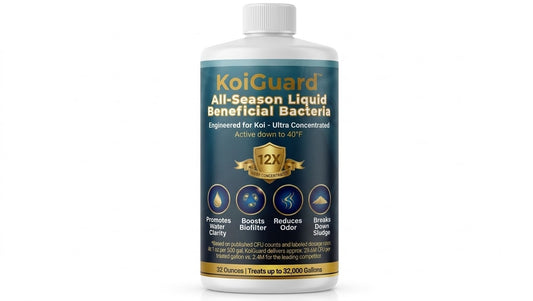
- Easy, accurate dosing. Liquid products can be measured precisely with a measuring cup or the product's built-in dosing cap. There is little ambiguity about how much you are adding. For KoiGuard Liquid Beneficial Bacteria, the dosing is straightforward: 8 fl oz per 1,000 gallons as a Day 1 loading dose, then 4 fl oz per 1,000 gallons for weekly maintenance.
- Even distribution. Pouring a liquid into your pond or directly over filter media ensures relatively even coverage. The bacteria disperse throughout the water column and settle onto available surfaces.
Considerations with Liquid Bacteria
- Shelf life is more limited. Because the bacteria are in an active or semi-active state, liquid products have a finite shelf life. They should be stored in a cool, dark location and used within the timeframe indicated on the packaging. Extreme heat or freezing can reduce viability.
- Heavier to ship and store. Water is heavy. A gallon of liquid bacteria weighs approximately eight pounds, which impacts shipping costs and storage space — particularly for large-pond owners who go through significant volumes.
- Cost per dose can be higher. Because you are paying for the water content in addition to the bacteria, liquid products can have a higher per-application cost compared to dry concentrates, especially at larger pond volumes.
How Dry Beneficial Bacteria Is Formulated
Dry beneficial bacteria products contain the same core organisms, but in a desiccated, dormant state. Through controlled drying processes (often freeze-drying or spray-drying), the bacteria are reduced to a concentrated powder or granular form. The organisms are alive but metabolically inactive — in a state of suspended animation that preserves viability for extended periods.
When dry bacteria are rehydrated with water, the organisms reactivate over a period of minutes to hours, resume metabolic function, and begin colonizing available surfaces in your pond and biofilter.
Advantages of Dry Bacteria
- Extended shelf life. Dry formulations maintain viability significantly longer than liquid products when stored properly. A sealed container of dry bacteria kept in a cool, dry location retains its potency for much longer than an equivalent liquid product. This makes it practical to buy in larger quantities without waste.
- Highly concentrated. Without the water content, dry products pack substantially more bacteria per unit of weight. A small container of dry bacteria can treat the same volume of water as a much larger bottle of liquid — a significant advantage for storage and shipping.
- Cost-effective for large ponds. Because of the concentration factor, the cost per dose tends to be lower with dry formulations, especially for ponds above 5,000 gallons where liquid volumes become substantial. If you maintain a large pond or multiple ponds, the economics of dry bacteria become increasingly favorable.
- Lighter and easier to ship. A container of dry bacteria weighs a fraction of its liquid equivalent. This translates to lower shipping costs and easier handling.
- Temperature resilience during storage. Dry bacteria in their dormant state are more tolerant of temperature fluctuations during shipping and storage, though they should still be kept away from extreme heat.
Considerations with Dry Bacteria
- Requires preparation. For optimal results, dry bacteria should be mixed into a slurry with pond water before application. This rehydration step activates the organisms and ensures even distribution. Simply sprinkling dry powder onto the pond surface can result in uneven dispersal and slower activation.
- Slightly slower initial activation. The rehydration and reactivation process means there is a short lag compared to liquid bacteria, which are already in a hydrated state. In practice, this difference is usually measured in hours rather than days, but it is worth noting for emergency situations.
- Measuring requires a scoop. Volumetric dosing with a scoop is slightly less precise than measuring a liquid, though this margin is small and inconsequential for most applications. KoiGuard Dry Beneficial Bacteria includes a dosing scoop calibrated to the recommended amounts: 4 scoops per 1,000 gallons for Day 1, and 2 scoops per 1,000 gallons for weekly maintenance.
How to Prepare a Dry Bacteria Slurry
If you choose a dry formulation, proper preparation maximizes effectiveness. The process is simple:
- Step 1: Fill a clean bucket with pond water (not tap water — chlorine kills bacteria). Use approximately one to two gallons of pond water.
- Step 2: Measure your dry bacteria dose based on your pond volume.
- Step 3: Add the dry bacteria to the bucket of pond water and stir gently for 30 to 60 seconds. The goal is even dispersion, not vigorous agitation.
- Step 4: Let the slurry sit for five to ten minutes. This allows the bacteria to begin rehydrating.
- Step 5: Pour the slurry directly into your biofilter, over filter media, or distribute it around the pond's perimeter. Applying near your filter intake helps direct bacteria toward colonization surfaces.
This preparation step adds roughly 10 to 15 minutes to your maintenance routine. For weekly applications, some pond keepers find this inconvenient. For others, it is a minor addition to an already-scheduled maintenance session.
Direct Comparison: Liquid vs Dry at a Glance
- Ease of use: Liquid requires no preparation. Dry requires making a slurry for best results.
- Speed of activation: Liquid is faster. Dry requires rehydration time but catches up within hours.
- Shelf life: Dry lasts significantly longer. Liquid should be used within its indicated timeframe.
- Cost per dose: Dry is typically more cost-effective, especially for larger ponds.
- Storage and shipping: Dry is lighter, more compact, and easier to store.
- Dosing precision: Liquid is slightly more precise with volumetric measurement. Dry uses a calibrated scoop.
- Effectiveness: Equivalent when both are properly applied. The bacteria are the same; only the delivery format differs.
When to Choose Liquid
Liquid beneficial bacteria is the better choice if:
- You have a small to medium pond (under 5,000 gallons) where the cost difference is minimal.
- Convenience is your top priority, and even a small preparation step makes you less likely to dose consistently.
- You are dealing with an urgent water quality issue and need the fastest possible bacterial response.
- You prefer pour-and-go simplicity for weekly maintenance.
When to Choose Dry
Dry beneficial bacteria is the better choice if:
- You have a large pond (5,000+ gallons) where the cost savings compound over a season of weekly dosing.
- You maintain multiple ponds and need to treat significant total volume.
- You want to buy in bulk and store product for the full season without worrying about shelf life.
- Shipping cost is a consideration, particularly for remote locations or frequent orders.
- You are already doing weekly maintenance sessions and the slurry preparation step fits naturally into your routine.
Can You Switch Between Formats?
Absolutely. The bacteria are biologically identical regardless of delivery format. You can use liquid for your Day 1 loading dose when fast activation matters most, then switch to dry for ongoing weekly maintenance when cost-effectiveness becomes the priority. There is no compatibility concern.
Some pond keepers keep a bottle of liquid on hand for emergency situations (post-medication, ammonia spikes, after a filter cleaning) and use dry for routine weekly dosing. This hybrid approach is perfectly sound. You can explore both options in the KoiGuard Beneficial Bacteria collection.
What About Combined Bacteria and Enzyme Products?
If you are using both beneficial bacteria and pond enzymes — which most ponds benefit from — a combined product simplifies your routine regardless of format preference. KoiGuard BeneZyme pairs both biological systems in a single application, eliminating the need to manage separate products and dosing schedules.
Storage Best Practices for Either Format
- Liquid bacteria: Store in a cool, dark location between 40 and 80 degrees Fahrenheit. Do not freeze. Do not leave in direct sunlight. Keep the cap tightly sealed between uses. Shake gently before each application to redistribute settled organisms.
- Dry bacteria: Store in a cool, dry location. Keep the container sealed to prevent moisture absorption, which can prematurely activate dormant bacteria. Avoid extreme heat. A garage shelf or indoor closet works well for most climates.
A Note on Quality and Bacterial Count
Not all beneficial bacteria products are created equal, regardless of format. The critical factor is the concentration of viable colony-forming units (CFUs) — the number of living bacteria that can actually colonize and function in your pond. Low-quality products may contain bacteria that are dead on arrival, insufficient in concentration, or composed of species that are not relevant to the nitrogen cycle in a koi pond.
When evaluating any beneficial bacteria product, look for specific information about bacterial species, concentration, and formulation standards. Products designed specifically for koi ponds with known fish loads and biofilter requirements will outperform generic "pond conditioner" products. The KoiGuard Science page provides detail on what goes into a properly formulated beneficial bacteria product.
The Bottom Line
Liquid and dry beneficial bacteria contain the same organisms and achieve the same biological outcome: a functioning nitrogen cycle that keeps your koi safe from ammonia and nitrite toxicity. The choice between them comes down to practical considerations — your pond size, your budget, your tolerance for preparation steps, and how you structure your maintenance routine.
For smaller ponds and pond keepers who value maximum convenience, liquid is hard to beat. For larger ponds and keepers who are comfortable with a brief preparation step, dry offers superior cost-effectiveness and shelf life. Neither format is objectively "better" — only better suited to specific circumstances.
The most important factor is not which format you choose. It is that you use beneficial bacteria consistently, at the correct dose, on a regular schedule. A perfectly applied dry dose and a perfectly applied liquid dose produce the same result. A missed dose, regardless of format, produces nothing. Consistency is what builds and maintains the biological filtration your koi depend on. For dosing guidance based on your specific pond, visit the KoiGuard Pond Calculator.