How to Start Up a Koi Pond in Spring Without Triggering Water Quality Problems
Kelly CookeHow to Start Up a Koi Pond in Spring Without Triggering Water Quality Problems
Spring is the most dangerous season for koi. That statement surprises most pond keepers, who tend to associate risk with winter freezes or summer heat. But the data tells a different story: the majority of fish losses, disease outbreaks, and severe water quality crashes occur during the transition from winter dormancy to active season. The reason is straightforward — everything in your pond is waking up at different rates, and the gap between biological oxygen demand and biological filtration capacity is at its widest in early spring.
This guide provides a structured, week-by-week approach to spring startup that keeps your koi safe, your water chemistry stable, and your biofilter functional from day one.
Why Spring Is So Risky for Koi
During winter, your pond's biological systems slow dramatically. Beneficial bacteria colonies in your biofilter become dormant or die back significantly as water temperatures drop below 50 degrees Fahrenheit. Your koi's immune systems are suppressed in cold water, making them vulnerable to opportunistic pathogens. Organic debris — leaves, dead plant material, fish waste from fall — has been accumulating and slowly decomposing on the pond bottom for months.
Then spring arrives. Water temperatures climb. Your koi become more active and start producing waste again. Opportunistic bacteria and parasites activate. And your biofilter? It is essentially starting from scratch, with a fraction of the bacterial population it had in late summer.
The result is a predictable window of vulnerability: fish are producing ammonia, pathogens are active, immune systems are still compromised, and the nitrogen cycle is not yet established. Every decision you make during these first few weeks either shortens or extends that window.
The 50-Degree Rule: When to Actually Start
Do not begin your spring startup protocol until water temperatures are consistently at or above 50 degrees Fahrenheit (10 degrees Celsius). A single warm afternoon that pushes the thermometer to 55 degrees does not count. You need sustained temperatures — measured at the same time each morning for several consecutive days — at or above this threshold.
Why 50 degrees? This is the approximate lower bound for meaningful beneficial bacteria activity. Below this temperature, bacteria metabolism is too slow to process ammonia and nitrite at any useful rate. Starting your feeding and treatment schedule before your biology can keep pace is one of the most common spring mistakes.
Invest in a Reliable Thermometer
A floating pond thermometer or a digital probe thermometer placed at mid-depth gives you the most accurate reading. Surface temperature can fluctuate dramatically with sun exposure and air temperature. Mid-depth readings reflect what your fish and bacteria are actually experiencing.
Week-by-Week Spring Startup Schedule
Week 1: Assess and Clean (Water Temperature Reaches 50 Degrees Fahrenheit)
Your first task is evaluation, not action. Resist the urge to do everything at once.
- Test your water. Measure ammonia, nitrite, nitrate, pH, and KH. Record these as your baseline. Do not be alarmed if readings are slightly off — you are establishing a starting point.
- Remove large debris. Use a pond net to remove leaves, twigs, and any large organic material from the surface and bottom. Do not vacuum the entire bottom aggressively — disturbing settled sludge releases trapped ammonia and hydrogen sulfide.
- Inspect equipment. Check your pump, filter, UV clarifier, aeration system, and plumbing for winter damage. Start your pump and filtration system. Do not turn on your UV clarifier yet.
- Perform a partial water change. Replace 10 to 15 percent of pond water with dechlorinated fresh water. This dilutes any accumulated dissolved organics without shocking your fish.
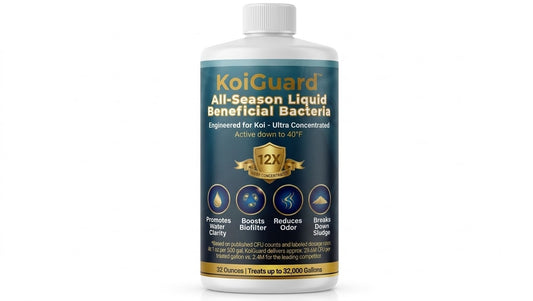
- Seed your biofilter with beneficial bacteria. This is the single most important step in spring startup. Apply a loading dose directly to your filter media and pond. For KoiGuard Beneficial Bacteria, the Day 1 loading dose is 8 fl oz (liquid) or 4 scoops (dry) per 1,000 gallons. If you are unsure of your pond volume, the KoiGuard Pond Calculator will give you an accurate estimate.
- Add enzymes. Apply a loading dose of pond enzymes to begin breaking down the organic sludge that accumulated over winter. This reduces the ammonia load your newly introduced bacteria will face. The Day 1 enzyme dose is 8 fl oz per 1,000 gallons.
- Keep UV off. Leave your UV clarifier off for at least 24 hours after bacteria application to allow the organisms time to colonize surfaces before being exposed to ultraviolet sterilization.
Week 2: Begin Light Feeding
- Start feeding sparingly. Offer a small amount of easily digestible, wheat germ-based koi food once every other day. Your koi's digestive systems are still sluggish, and any uneaten food becomes an ammonia source. Feed only what they consume in two to three minutes.
- Test water every two days. Watch ammonia and nitrite closely. Any reading above 0.25 ppm ammonia or 0.25 ppm nitrite means your biofilter is not yet keeping pace. Reduce feeding further if levels are rising.
- Apply weekly maintenance dose of bacteria. Continue supporting your biofilter with a weekly bacteria dose: 4 fl oz (liquid) or 2 scoops (dry) per 1,000 gallons.
- Apply weekly enzyme dose. Maintain enzyme treatments at 4 fl oz per 1,000 gallons weekly to continue breaking down organic debris.
- Observe your fish. Look for signs of stress or disease: clamped fins, flashing (rubbing against surfaces), lethargy, isolation from the group, or visible spots and lesions. Early spring is when parasites like Ich and Costia become active.
Week 3: Monitor and Adjust
- Increase feeding gradually. If ammonia and nitrite remain at zero or near-zero, move to feeding once daily in small amounts. Continue with easily digestible food — save the high-protein growth food for when temperatures are consistently above 65 degrees Fahrenheit.
- Continue weekly bacteria and enzyme doses. Your biofilter is building but not yet mature. Consistent dosing throughout spring is what establishes a robust bacterial colony by summer. Using a combined product like KoiGuard BeneZyme simplifies this into a single weekly application.
- Perform a 10 percent water change if needed. If ammonia or nitrite readings creep up, a partial water change provides immediate dilution while your bacteria catch up.
- Turn on UV clarifier. By week three, your bacteria should be established enough on filter media that UV operation will not significantly impact their colonies. UV will help control free-floating algae and pathogens.
Week 4: Approaching Stability
- Test water twice this week. You should see ammonia and nitrite consistently at zero, with rising nitrate levels — the hallmark of a functioning nitrogen cycle.
- Continue weekly maintenance doses. Do not stop bacteria and enzyme applications because your water looks good. Consistent dosing maintains the colony and prevents the boom-bust cycles that destabilize water chemistry.
- Transition to regular feeding schedule. If readings are stable and temperatures are consistently above 60 degrees, you can move to a normal feeding routine with appropriate seasonal food.
- Resume normal maintenance. Your pond is now transitioning from startup mode to active-season maintenance. Continue weekly water testing, weekly bacteria and enzyme dosing, and regular debris removal.
The Five Most Common Spring Mistakes
1. Feeding Too Soon or Too Much
This is the single most common spring error. Koi become active and appear hungry before their digestive systems — and your biofilter — are ready. Every gram of food that is not efficiently digested becomes ammonia. Wait for sustained 50-degree temperatures, start with small amounts, and increase slowly based on water test results, not based on how eagerly your fish approach the surface.
2. Skipping Bacteria Application
Many pond keepers assume their biofilter "comes back" on its own in spring. It does eventually — but the lag time can be weeks, during which ammonia and nitrite levels are unmanaged. Seeding your filter with a concentrated dose of beneficial bacteria on Day 1 of spring startup dramatically shortens the time to a functioning nitrogen cycle.
3. Cleaning the Biofilter Too Aggressively
Spring cleaning is satisfying, but scrubbing your biofilter media, rinsing it in tap water, or replacing it entirely destroys whatever bacterial colonies survived the winter. If your filter media needs cleaning, rinse it gently in a bucket of pond water — never tap water, which contains chlorine and chloramine that kill bacteria on contact.
4. Ignoring Water Testing
If you only test your water once in spring, you are flying blind. Ammonia and nitrite can spike within 48 hours under the right conditions. Test every two to three days for the first month, then weekly once readings stabilize. A good liquid test kit (not strips) for ammonia, nitrite, nitrate, pH, and KH is essential equipment, not optional.
5. Performing Massive Water Changes
A 50-percent water change in spring feels like a fresh start, but it shocks your fish with sudden temperature and chemistry swings. It also dilutes whatever beneficial bacteria are present in the water column. Stick to 10 to 15 percent changes, and only when water testing indicates a need.
Temperature and Dosing: A Quick Reference
Your bacteria and enzyme applications should align with water temperature throughout the season:
- 50 to 59 degrees Fahrenheit: Full dosing protocol as described above. Bacteria are active but slow. Consistent application is critical to build populations.
- 60 to 75 degrees Fahrenheit: Optimal bacteria growth range. Maintain weekly doses. This is when your biofilter truly matures.
- 76 to 90 degrees Fahrenheit: Bacteria are highly active, but so is ammonia production from increased fish metabolism and feeding. Maintain weekly dosing. Consider additional doses after heavy rain, water changes, or high fish loads.
For comprehensive dosing guidance, the KoiGuard FAQ page covers common scenarios and edge cases.
What About Salt, Medications, and Preventive Treatments?
Some pond keepers add salt or run prophylactic parasite treatments in early spring. If you choose to do so, be aware that certain medications — particularly antibiotics and formalin-based treatments — can harm or destroy beneficial bacteria. If you medicate in spring, plan on re-dosing your biofilter with bacteria once the treatment period is complete.
Salt at low concentrations (0.1 to 0.3 percent) generally does not impact beneficial bacteria and can help koi manage osmotic stress during the vulnerable spring period. However, salt does not evaporate — it only leaves through water changes. Monitor your salt concentration if you add it.
The Bottom Line
Spring startup is not a single afternoon project. It is a four-week process of gradually reactivating your pond's biological systems while keeping your koi safe during their most vulnerable period. The protocol is straightforward: wait for 50-degree sustained temperatures, seed your biofilter with beneficial bacteria and enzymes on Day 1, feed lightly and increase gradually, test water frequently, and maintain weekly dosing through the entire startup period.
The ponds that sail through spring without ammonia spikes, disease outbreaks, or fish losses are almost always the ponds where the keeper followed a disciplined, biology-first startup schedule. The upfront time investment is minimal. The payoff — healthy fish, clear water, and a mature biofilter by the time summer arrives — is substantial.
For more on the biology behind the nitrogen cycle and how beneficial bacteria work, visit the KoiGuard Science page.