How to Reduce Pond Sludge Without Tearing Everything Apart
Kelly CookeHow to Reduce Pond Sludge Without Tearing Everything Apart
There is a layer at the bottom of almost every pond that nobody wants to talk about. It is dark, it is soft, and if you disturb it, it smells terrible. Pond sludge — that accumulation of decomposing leaves, fish waste, uneaten food, and dead algae — is one of the most persistent problems in pond maintenance. The standard advice is to drain the pond, scrub everything, and start fresh. But that approach is disruptive, time-consuming, stressful for your fish, and often unnecessary. There are better ways to manage sludge, and the most effective ones work continuously in the background so you never face a major teardown in the first place.
What Pond Sludge Actually Is
Sludge is the collective term for organic debris that settles on the bottom of your pond and undergoes decomposition. It is not a single substance — it is a complex, layered mixture of multiple organic sources.
- Fallen leaves and plant debris. Trees near the pond shed leaves that sink and decompose. Aquatic plants drop dead foliage. In autumn, this can be the single largest contributor to sludge accumulation.
- Fish waste. Koi are prolific waste producers. Their fecal matter settles and becomes part of the sludge layer. In heavily stocked ponds, this alone can create a significant accumulation over a single season.
- Uneaten food. Any pellets or food that fish do not consume within a few minutes sink to the bottom and decompose. Overfeeding is one of the most common accelerators of sludge buildup.
- Dead algae. Algae that die — whether from UV treatment, algaecides, or natural die-off — settle to the bottom and add to the organic load.
- Dust, pollen, and airborne debris. Fine particles that land on the water surface eventually sink and contribute to the accumulation.
Over time, these materials compact into that familiar dark, mucky layer. The top portion is relatively fresh and still actively decomposing. The deeper layers become increasingly dense and oxygen-depleted, creating conditions that are genuinely problematic for your pond's ecosystem.
Why Sludge Is More Than an Aesthetic Problem
A thin layer of organic matter on the bottom of a pond is natural and even normal. The problems begin when that layer thickens beyond what your pond's biology can process. Here is why excess sludge is a serious concern.
Anaerobic Zones
As sludge thickens, oxygen cannot penetrate to the lower layers. Decomposition shifts from aerobic (oxygen-using) to anaerobic (oxygen-free). Anaerobic decomposition is slower, less complete, and produces toxic byproducts — most notably hydrogen sulfide, the compound responsible for that rotten egg smell when you stir the bottom. Hydrogen sulfide is toxic to fish even at low concentrations. A thick sludge layer is essentially a reservoir of toxic gas waiting to be released.
Nutrient Loading
Decomposing sludge continuously releases phosphates, nitrates, and other nutrients into the water column. These nutrients fuel algae growth, creating a feedback loop: sludge feeds algae, algae dies and becomes sludge, which feeds more algae. Ponds with heavy sludge accumulation almost always have persistent algae problems, and no amount of UV or algaecide will fix the root cause.
Water Quality Degradation
The ongoing decomposition process consumes dissolved oxygen from the water — oxygen your fish and beneficial bacteria need. It also depresses pH over time and can contribute to ammonia spikes, particularly when the sludge layer is disturbed by fish foraging along the bottom or during seasonal turnover events.
Fish Health
Koi are bottom feeders by nature. They actively forage in and around sludge deposits, which exposes them to concentrated levels of bacteria, parasites, and toxic compounds. Ponds with heavy sludge loads consistently show higher rates of bacterial infections, ulcers, and parasitic infestations. The sludge layer is quite literally a breeding ground for pathogens.
Mechanical Removal: The Direct Approach
Sometimes sludge has accumulated to the point where biological methods alone cannot catch up quickly enough. Mechanical removal gives you an immediate reduction in organic load.
Bottom Drains
If your pond was built with a bottom drain — or if retrofitting one is feasible — this is the most efficient ongoing mechanical sludge removal method. A properly designed bottom drain continuously pulls settled debris from the lowest point of the pond to an external settlement chamber or filter. Ponds with functional bottom drains accumulate sludge far more slowly than those without one. If you are building or renovating a pond, a bottom drain should be considered essential infrastructure, not an optional luxury.
Pond Vacuums
For ponds without bottom drains, a pond vacuum is the most practical tool for periodic sludge removal. These work similarly to a pool vacuum, suctioning debris from the bottom and either discharging it as waste water or passing it through a collection bag. When vacuuming, work methodically in sections. There is no need to remove every trace — the goal is to reduce the bulk of the accumulation, not to sterilize the bottom. Vacuuming once in spring and once in late fall after leaf drop covers most ponds' needs.
One important note on mechanical removal: every time you vacuum or disturb the bottom, you are releasing trapped nutrients and potentially toxic gases into the water column. Work slowly, do it on a day when you can monitor your fish, and consider running extra aeration during and after the process.
The Biological Approach: Enzymes and Bacteria
Mechanical removal addresses the symptom. Biological treatment addresses the process. The most effective long-term sludge management strategy combines both — but if you could only choose one, biology wins for sustainability.
How Enzymes Break Down Organic Matter
Enzymes are proteins that catalyze specific chemical reactions. In the context of pond sludge, enzyme formulations accelerate the breakdown of complex organic compounds — cellulose from leaves, proteins from fish waste, starches from uneaten food — into simpler molecules. They do not consume these materials themselves. Instead, they prepare organic matter for processing by bacteria.
Think of enzymes as the first stage of a two-stage digestion system. They take large, complex organic molecules and break them into smaller fragments that bacteria can then metabolize. Without adequate enzyme activity, organic material decomposes much more slowly, and bacteria are limited in what they can process.
How Bacteria Process the Byproducts
Once enzymes have broken sludge components into simpler molecules, beneficial bacteria consume those molecules as fuel for growth and reproduction. The end products of complete aerobic bacterial decomposition are carbon dioxide, water, and mineral compounds that are far less problematic than the original organic sludge. Essentially, bacteria convert solid muck into dissolved gases and simple nutrients — making the sludge disappear without you having to physically remove it.
Why the Enzyme-Plus-Bacteria Combination Is Most Effective
Neither enzymes nor bacteria alone are as effective as the two working together. Enzymes without bacteria leave you with broken-down organic fragments that still need to be processed. Bacteria without enzymes are limited to working on whatever small molecules are already available, leaving larger organic structures intact for much longer.
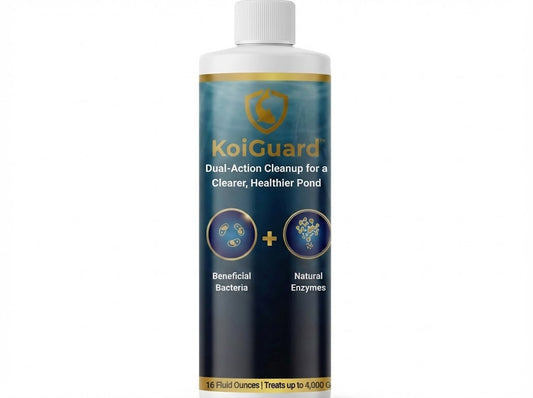
The combination creates a continuous breakdown pipeline: enzymes fragment complex organics, bacteria consume the fragments, and the sludge layer steadily diminishes. This is the principle behind products like KoiGuard BeneZyme, which combines both beneficial bacteria and enzyme complexes in a single formulation specifically designed for this two-stage process.
Implementing a Biological Sludge Reduction Program
Getting results from biological sludge treatment requires consistency rather than intensity. This is not a one-time application — it is an ongoing program.
Initial Assessment
Before you start, get a sense of how much sludge you are dealing with. Wade in carefully (or use a long pole) to gauge the depth of the layer in different areas of the pond. If sludge is more than 2 to 3 inches deep in most areas, consider doing a round of mechanical removal first to reduce the bulk, then switching to biological maintenance to prevent re-accumulation.
Starting Dose
Begin with a Day 1 loading dose of both enzymes and bacteria. For KoiGuard Pond Enzymes, this means 8 fl oz per 1,000 gallons. Dose bacteria at the same rate — 8 fl oz liquid or 4 scoops dry per 1,000 gallons. This initial high dose floods the system with the biological agents needed to begin processing the accumulated organic material. Remember to turn off UV sterilization for 24 hours after dosing bacteria.
Weekly Maintenance
Follow the initial dose with weekly applications at the maintenance rate: 4 fl oz of enzymes per 1,000 gallons, and 4 fl oz liquid bacteria (or 2 scoops dry) per 1,000 gallons. Consistency matters more than volume here. Regular weekly dosing maintains active enzyme and bacterial populations that continuously process new organic inputs as they arrive rather than allowing them to accumulate.
Realistic Timeline
Biological sludge reduction is not instant. Expect to see measurable results over weeks and months, not days. Most pond owners report noticeable reduction in sludge depth after 4 to 6 weeks of consistent treatment, with significant improvement by the 8 to 12 week mark. Heavier accumulations may take a full season to fully process. The key is that each week, the sludge layer gets a little thinner — and as long as you maintain the program, it stays that way.
Seasonal Sludge Management
Sludge does not accumulate evenly throughout the year. Understanding the seasonal pattern helps you target your efforts where they matter most.
Spring Cleanup
After winter, most ponds have accumulated debris from fall that was never fully processed because bacterial activity slows dramatically in cold water. Spring is the ideal time to do a mechanical vacuuming of the heaviest accumulations, followed by a biological program to handle the rest. Start enzyme and bacteria dosing as soon as water temperatures consistently reach 50°F — this is the lower threshold for meaningful bacterial activity.
Summer Maintenance
Warm water supports robust bacterial activity, making summer the most productive season for biological sludge reduction. Maintain your weekly dosing schedule throughout summer. This is when you will see the fastest results. It is also when fish are eating the most and producing the most waste, so consistent treatment prevents new accumulation while clearing old deposits.
Fall: The Critical Window
Falling leaves are the single largest source of sludge in most ponds. If you can do only one thing for sludge prevention, it should be installing a pond net in autumn before the leaves start falling. A net catches leaves before they enter the water, eliminating the problem at its source. For leaves that do get through, increase your enzyme dosing frequency to help break them down before they settle and compact into sludge. Remove the net and accumulated leaves before winter.
Winter
Below 50°F, bacterial activity declines sharply and enzyme function slows. There is little you can do biologically during winter. The goal is to enter winter with as little sludge as possible, which means the fall management window is critical. A pond that enters winter relatively clean will emerge in spring with a manageable organic load. A pond that enters winter buried in leaves will be a sludge-choked mess by March.
The Maintenance Approach vs. the Teardown
There are fundamentally two philosophies for managing pond sludge, and they produce very different outcomes.
The Teardown Approach
Drain the pond. Remove the fish to a holding tank. Pressure wash every surface. Scrub the filters. Refill with fresh water. Start the nitrogen cycle from scratch. This gives you a clean pond — for about two weeks, until organic material begins accumulating again. Meanwhile, your fish have been stressed by the move, your biofilter has been completely destroyed, and you are facing weeks of cycling before the pond is biologically stable. Many pond keepers do this once or twice a year and accept the associated risks as normal. It is not normal. It is unnecessarily destructive.
The Maintenance Approach
Keep the pond running. Use mechanical removal selectively for the worst accumulations. Run a consistent biological program of enzymes and bacteria to continuously process organic inputs. Manage leaf fall with netting. Avoid overfeeding. Vacuum lightly once or twice a year in targeted areas. The pond never gets to the point where a teardown feels necessary because organic waste is being processed in real time.
The maintenance approach wins. It is less work over the course of a year. It is dramatically less stressful for your fish. It preserves your biological filtration. And it produces better long-term water quality because you are managing the problem continuously rather than letting it accumulate to crisis levels and then resetting.
Additional Sludge Prevention Practices
Beyond enzymes and bacteria, these habits reduce the rate at which sludge accumulates in the first place.
- Do not overfeed. Feed only what your fish can consume in 3 to 5 minutes. Any food that sinks uneaten is future sludge.
- Use a skimmer. A surface skimmer pulls floating debris — leaves, pollen, insects — out of the pond before it sinks and decomposes. If your pond does not have one, it is one of the highest-impact upgrades you can make.
- Trim overhanging vegetation. Trees and shrubs that hang over the pond are a constant source of organic input. Prune them back where practical.
- Maintain adequate flow. Dead spots with poor circulation accumulate sludge faster than areas with good water movement. Position returns and jets to minimize stagnant zones.
- Clean prefilters regularly. Mechanical prefilters catch debris before it enters your biological filtration. If they are clogged, debris bypasses them and settles in the pond.
For calculating dosing amounts based on your specific pond volume, use the KoiGuard Pond Calculator.
The Bottom Line
Pond sludge is the accumulated result of organic material that enters your pond faster than biology can break it down. It creates anaerobic zones, releases toxic hydrogen sulfide, fuels algae growth, and degrades water quality and fish health. You do not need to tear your pond apart to address it. The most effective approach combines targeted mechanical removal for heavy accumulations with a consistent biological program of enzymes and beneficial bacteria. Enzymes fragment complex organic matter; bacteria consume the fragments. Together, they steadily reduce existing sludge and prevent new buildup. Start in spring when water temperatures reach 50°F, dose weekly through the season, manage leaf fall aggressively in autumn, and maintain the program year after year. The maintenance approach is less work, less risk, and produces a cleaner pond than any annual teardown ever will.