How Often Should You Add Beneficial Bacteria to a Koi Pond?
Kelly CookeHow Often Should You Add Beneficial Bacteria to a Koi Pond?
One of the most frequently asked questions in koi keeping has a deceptively simple answer — and a much more nuanced reality underneath it. The short answer: once per week during the active season. The longer answer involves understanding why that frequency matters, what happens when you deviate from it, and the specific situations that call for additional or adjusted dosing. Beneficial bacteria are not a one-time addition. They are an ongoing biological input that sustains the nitrogen cycle your fish depend on for survival.
This guide covers the complete dosing picture — from your first application through seasonal adjustments, special circumstances, and the mistakes that lead to water quality problems even when pond keepers think they are dosing correctly.
The Two-Phase Dosing Protocol
Every beneficial bacteria program begins with two distinct phases: an initial loading dose and ongoing maintenance doses. These serve different purposes and use different quantities.
Day 1: The Loading Dose
The loading dose is a concentrated initial application designed to rapidly establish a bacterial population in your pond and biofilter. This is appropriate when:
- You are starting a brand-new pond
- You are opening your pond for spring after winter dormancy
- You have just completed a medication treatment that may have killed existing bacteria
- You have cleaned or replaced your biofilter media
- You are recovering from a significant water quality event (ammonia or nitrite spike)
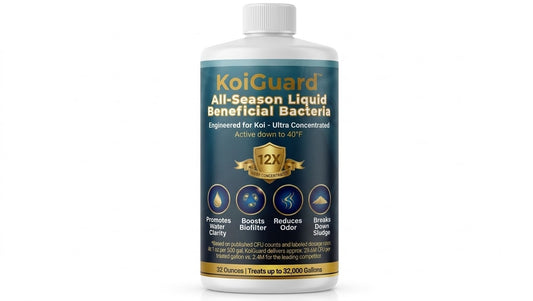
The loading dose for KoiGuard Beneficial Bacteria is 8 fl oz (liquid) or 4 scoops (dry) per 1,000 gallons of pond water. This is double the weekly maintenance amount and provides a concentrated inoculation that jumpstarts colonization of your biofilter media, pond surfaces, and any other available substrate.
Apply the loading dose directly to your biofilter or near filter intakes for best results. If using the dry formulation, prepare a slurry with pond water before application. And critically: turn off your UV clarifier for 24 hours after application. UV light is designed to kill microorganisms in the water column, and you do not want it eliminating your bacteria before they have time to attach to surfaces.
Weekly: The Maintenance Dose
Beginning one week after your loading dose, shift to the weekly maintenance amount: 4 fl oz (liquid) or 2 scoops (dry) per 1,000 gallons. This ongoing application replenishes bacterial populations that naturally decline due to die-off, filter cleaning, water changes, environmental stress, and normal population fluctuations.
The maintenance dose is not optional supplementation — it is a core component of biological filtration management. Even a well-established biofilter benefits from regular bacterial inputs because pond conditions are constantly changing. Fish loads fluctuate. Water chemistry shifts. Filter media gets cleaned. Weather events dilute bacterial populations. The weekly dose ensures your nitrogen cycle has the biological workforce it needs to keep pace with ammonia production.
Why Weekly Dosing Is the Standard
The weekly frequency is not arbitrary. It is based on bacterial growth dynamics and practical water quality management:
- Bacterial generation time: Under optimal conditions (65 to 85 degrees Fahrenheit, adequate oxygen, available ammonia), nitrifying bacteria divide approximately every 12 to 24 hours. A weekly dose provides a population boost that compounds on the existing colony's natural reproduction.
- Population stability: Bacterial populations in a pond biofilter are in constant flux. Die-off from environmental stress, competition, predation by protozoa, and mechanical disturbance during maintenance all reduce numbers. Weekly additions smooth these fluctuations and prevent the population dips that lead to ammonia and nitrite spikes.
- Practical compliance: A weekly schedule is easy to remember and integrate into a regular maintenance routine. More frequent dosing offers diminishing returns for most ponds. Less frequent dosing creates gaps that allow population declines between applications.
Seasonal Adjustments to Your Dosing Schedule
The active season for beneficial bacteria aligns with water temperature. Adjusting your dosing frequency and expectations to match the season improves outcomes and avoids waste.
Spring (50 to 65 Degrees Fahrenheit)
This is the most critical dosing period of the year. Your biofilter is rebuilding from winter dormancy, fish are resuming waste production, and bacterial metabolism is still relatively slow in cooler water. Apply a loading dose on Day 1 of spring startup, then maintain strict weekly dosing throughout the spring transition. Do not skip weeks during this period — your nitrogen cycle is fragile and under establishment.
Spring is also when pairing bacteria with pond enzymes provides the greatest benefit, as accumulated winter organic debris creates a heavy load for your developing bacterial colonies.
Summer (65 to 90 Degrees Fahrenheit)
Your biofilter is at peak capacity, bacterial metabolism is at its highest, and fish are eating and producing waste at maximum rates. Maintain weekly dosing without interruption. In summer, the ammonia production from heavy feeding and high metabolism is also at its peak — your bacteria need to match that output.
Consider additional doses (beyond the weekly schedule) after the following summer events:
- Heavy rainstorms that dilute pond water and potentially introduce contaminants
- Water changes exceeding 20 percent of pond volume
- Adding new fish to the pond (increased bioload)
- Cleaning or rinsing filter media
- Power outages that interrupt aeration or filtration for extended periods
Fall (65 to 50 Degrees Fahrenheit)
As temperatures decline, reduce feeding and begin tapering expectations for bacterial activity. Continue weekly dosing as long as water temperatures remain above 50 degrees Fahrenheit. Bacteria are still active in this range, and the organic load from falling leaves and dying aquatic plants creates additional ammonia sources that need processing.
Winter (Below 50 Degrees Fahrenheit)
Below 50 degrees, nitrifying bacteria become largely dormant. Dosing during winter is not harmful, but it provides minimal benefit since bacterial metabolism is insufficient for meaningful colonization or nitrogen processing. Most pond keepers suspend dosing during winter and resume with a loading dose at spring startup.
If you live in a mild climate where water temperatures rarely drop below 50 degrees, continue monthly maintenance doses through winter to sustain baseline populations.
Special Circumstances That Call for Extra Dosing
After Medication Treatments
This is one of the most important — and most frequently overlooked — dosing situations. Many common koi medications are harmful to beneficial bacteria:
- Antibiotics (amoxicillin, erythromycin, kanamycin) directly kill bacteria, including the beneficial species in your biofilter.
- Formalin and potassium permanganate are broad-spectrum oxidizers that can damage bacterial colonies.
- Copper-based treatments are toxic to many microorganisms at therapeutic concentrations.
After completing any medication treatment, apply a full loading dose (not just a maintenance dose) of beneficial bacteria. Your biofilter may need to be substantially rebuilt. Monitor ammonia and nitrite closely for the two weeks following medication — this is effectively a mini nitrogen cycle restart.
After Significant Water Changes
A routine 10 to 15 percent water change has minimal impact on your bacterial population — most bacteria are attached to surfaces, not free-floating. However, water changes exceeding 25 percent dilute the water column bacteria and can alter water chemistry (temperature, pH, mineral content) enough to stress established colonies.
After a large water change, apply a maintenance dose of bacteria and turn off your UV for 24 hours. If the water change exceeded 50 percent (which should be rare outside of emergencies), apply a full loading dose.
After Heavy Rainfall
A significant rainstorm can dilute your pond substantially, lower the water temperature rapidly, introduce runoff contaminants, and shift pH. All of these stress bacterial colonies. If a storm adds more than a few inches of water to your pond, consider an additional bacteria application within 24 to 48 hours.
After Filter Cleaning
Even gentle filter cleaning dislodges some bacterial biofilm. Aggressive cleaning — particularly rinsing media in tap water — can devastate your colony. After any filter maintenance, apply at minimum a maintenance dose. After aggressive cleaning or media replacement, apply a loading dose.
For a comprehensive list of frequently asked dosing questions, the KoiGuard FAQ page covers additional scenarios.
Common Dosing Mistakes
Under-Dosing: The "Some Is Better Than None" Trap
Some pond keepers apply bacteria sporadically — once a month, or whenever they remember, or only when water looks cloudy. While any bacteria is theoretically better than none, inconsistent dosing fails to establish the stable, self-sustaining colony that weekly application builds. You end up in a perpetual startup phase where the population never reaches the density needed for reliable nitrogen processing.
Over-Dosing: Is It Possible?
In practical terms, you cannot overdose beneficial bacteria in a way that harms your fish. Bacteria are self-limiting — their population is constrained by available surface area, oxygen, and food supply (ammonia). Excess bacteria simply die off when they cannot find colonization sites or adequate resources.
That said, over-dosing is a waste of product and money. If your water tests show ammonia and nitrite consistently at zero, your current dosing rate is adequate. There is no benefit to doubling or tripling the recommended maintenance dose as a precaution. Save additional dosing for the specific circumstances outlined above.
Dosing Without Turning Off UV
This is surprisingly common and significantly reduces the effectiveness of your bacteria application. UV clarifiers kill microorganisms — that is their purpose. Bacteria added to a pond with an active UV system are killed in the water column before they can reach and colonize your biofilter media. Every bacteria application should be accompanied by a 24-hour UV shutdown. Mark it on your calendar. Set a phone reminder to turn the UV back on the next day.
Stopping Dosing Because the Water Looks Good
Clear water and zero ammonia readings are the result of consistent dosing, not a signal to stop. The moment you cease regular bacteria applications, your colony begins a slow decline. It may take weeks to manifest as a water quality problem, which creates a false sense that dosing was unnecessary. Then the ammonia spike hits, and you are back to emergency mode. Maintain your weekly schedule through the entire active season, regardless of how good the water looks.
Building a Dosing Routine That Sticks
The most effective dosing schedule is the one you actually follow. A few practical tips for consistency:
- Pick the same day each week. Sunday mornings, Wednesday evenings, whenever works for your schedule. Make it a standing appointment.
- Pair it with another routine. Dose bacteria when you feed your fish, test your water, or clean your skimmer basket. Attaching it to an existing habit makes it automatic.
- Keep your product accessible. Store your bacteria where you will see it during pond maintenance — not buried in a garage cabinet. Out of sight is out of mind.
- Track your applications. A simple log — even a note on your phone — helps you see patterns, catch missed weeks, and correlate water test results with your dosing history.
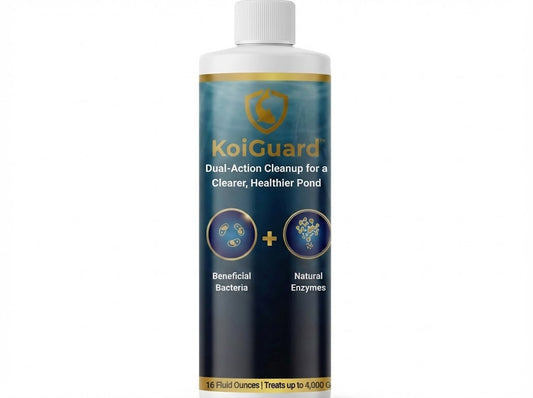
Using a single product like KoiGuard BeneZyme that combines beneficial bacteria and enzymes in one formula reduces the number of products to manage, making it easier to maintain a consistent routine.
How to Know If Your Dosing Schedule Is Working
The proof is in your water test results. A properly dosed pond should show:
- Ammonia: Consistently at 0 ppm
- Nitrite: Consistently at 0 ppm
- Nitrate: Present (typically 5 to 40 ppm), indicating the nitrogen cycle is completing. Controlled through water changes and plant uptake.
- Stable pH: Minimal fluctuations between tests, indicating consistent biological activity.
If you are dosing weekly and still seeing ammonia or nitrite readings above zero, evaluate these factors before increasing your dose:
- Is your pond overstocked relative to your filtration capacity?
- Are you overfeeding?
- Is your UV running during bacteria applications?
- Has your filter media been recently cleaned or replaced?
- Is your water temperature within the active range of 50 to 90 degrees Fahrenheit?
The KoiGuard Pond Calculator can help you verify that your dosing amounts are correctly calibrated to your actual pond volume.
The Bottom Line
Beneficial bacteria dosing follows a clear, repeatable protocol. Start with a loading dose on Day 1 — whether that is a new pond, spring startup, or post-medication recovery. Then maintain weekly applications at the standard maintenance rate throughout the active season (water temperatures between 50 and 90 degrees Fahrenheit). Add supplemental doses after specific events: large water changes, heavy storms, filter cleaning, or medication treatments.
The pattern that produces the best long-term results is not aggressive dosing — it is consistent dosing. A moderate amount of bacteria applied reliably every week outperforms large sporadic doses separated by weeks of neglect. Your biofilter is a living system that requires steady inputs to maintain the population density needed for effective ammonia and nitrite processing.
Treat your weekly bacteria dose like feeding your fish: it is not something you do when you remember. It is a non-negotiable part of responsible koi keeping. Your fish — and your water test results — will reflect the difference. For more on the biological principles behind the nitrogen cycle, visit the KoiGuard Science page.