Beneficial Bacteria vs Enzymes: Which Does Your Pond Actually Need?
Kelly CookeBeneficial Bacteria vs Enzymes: Which Does Your Pond Actually Need?
If you've spent any time researching koi pond water quality, you've almost certainly encountered two products that sound similar but do very different things: beneficial bacteria and pond enzymes. Both promise cleaner water. Both claim to reduce maintenance. And both sit next to each other on the shelf, leaving pond keepers wondering which one they actually need — or whether they need both. The answer matters more than you might think, because choosing the wrong one (or skipping the right one) can mean the difference between crystal-clear water and a persistent battle with ammonia spikes, murky green conditions, and bottom sludge that never seems to go away.
This guide breaks down exactly what each product does at the biological level, when to use one versus the other, and why the most effective pond maintenance programs use both.
What Beneficial Bacteria Actually Do
Beneficial bacteria are living microorganisms — primarily species of Nitrosomonas and Nitrobacter — that colonize your pond's biofilter, rocks, liner surfaces, and any other porous media available. Their job is specific and critical: they convert toxic nitrogen compounds into progressively less harmful forms through a process called the nitrogen cycle.
Here is the sequence in plain terms:
- Ammonia (NH3) is produced by fish waste, uneaten food, and decomposing organic matter. Even small concentrations are toxic to koi.
- Nitrosomonas bacteria consume ammonia and convert it to nitrite (NO2), which is still toxic.
- Nitrobacter bacteria then convert nitrite to nitrate (NO3), which is far less harmful and is absorbed by aquatic plants or removed through water changes.
Without a healthy population of these bacteria, ammonia and nitrite accumulate rapidly — especially in stocked koi ponds where fish are producing waste constantly. This is why new ponds experience "new pond syndrome," and why established ponds can crash after medication treatments, deep cleanings, or long winters that kill off bacterial colonies.
Where Bacteria Live
Beneficial bacteria are not free-floating. They form biofilms — thin, sticky colonies that adhere to surfaces. Your biofilter media, filter pads, rocks, and even the pond liner all host these colonies. This is why aggressive filter cleaning (rinsing media in chlorinated tap water, for example) is so destructive. You are literally washing away the biology that keeps your fish alive.
What Bacteria Cannot Do
Here is the critical distinction most pond keepers miss: beneficial bacteria process dissolved nitrogen compounds. They do not break down leaves sitting on the bottom of your pond. They do not digest fish food that sank before your koi got to it. They do not reduce the thick layer of organic sludge accumulating in your skimmer bay. That is a different job entirely — and it belongs to enzymes.
What Pond Enzymes Actually Do
Enzymes are not living organisms. They are biological catalysts — proteins that accelerate specific chemical reactions. In the context of a koi pond, enzyme products contain a targeted blend of proteases, lipases, amylases, and cellulases that break down different categories of organic waste:
- Proteases break down protein-based waste (fish waste, uneaten food).
- Lipases break down fats and oils (common from fish food, especially high-protein koi diets).
- Amylases break down starches.
- Cellulases break down plant cellulose (leaves, dead algae, organic debris).
The result is a measurable reduction in bottom sludge, improved water clarity, and less organic load on your filtration system. Enzymes essentially pre-digest the solid waste that bacteria alone cannot efficiently process.
Where Enzymes Work
Unlike bacteria, enzymes work throughout the water column and on surfaces. They do not need to colonize anything. Once introduced, they immediately begin catalyzing reactions wherever they encounter their target substrates. This makes them particularly effective for ponds with heavy organic debris loads — fall leaf accumulation, spring pollen, post-winter sludge buildup, or ponds with dense fish populations producing large volumes of solid waste.
What Enzymes Cannot Do
Enzymes do not process ammonia or nitrite. They have zero role in the nitrogen cycle. A pond dosed exclusively with enzymes and no beneficial bacteria will still experience dangerous ammonia and nitrite levels. Enzymes handle the solid and suspended organic waste; bacteria handle the dissolved toxins. They are complementary systems, not interchangeable ones.
A Simple Way to Remember the Difference
Think of your pond's waste processing in two stages:
- Stage 1 — Enzymes: Break down large organic particles (sludge, debris, uneaten food) into smaller dissolved compounds.
- Stage 2 — Bacteria: Convert those dissolved compounds (especially ammonia and nitrite) into safe end products.
Skipping Stage 1 means your bacteria are overwhelmed by organic load and your pond accumulates sludge. Skipping Stage 2 means dissolved toxins build to dangerous levels regardless of how clean the bottom looks. Both stages need to be functioning for a truly balanced system.
When to Use Bacteria Alone
There are situations where beneficial bacteria are the priority and enzymes are secondary:
- New pond cycling: When you are establishing the nitrogen cycle for the first time, bacteria are non-negotiable. Enzymes are helpful but not the immediate priority.
- After medication: Antibiotics and anti-parasitic treatments often decimate bacterial colonies. Re-seeding with beneficial bacteria should happen immediately after the treatment period ends.
- Ammonia or nitrite emergency: If your test kit shows elevated ammonia or nitrite, you need bacteria — not enzymes. Enzymes will not address nitrogen toxicity.
- Minimal organic debris: If your pond has excellent mechanical filtration, few trees nearby, and a modest fish load, enzymes may be less urgent while bacteria remain essential.
When to Use Enzymes Alone
Enzymes as a standalone treatment make sense in fewer situations, but they exist:
- Established ponds with mature biofilters that have persistent sludge buildup or clarity issues despite healthy nitrogen cycle readings.
- Seasonal debris management: A targeted enzyme application in fall when leaves are entering the pond, or in spring to break down winter accumulation.
- Ponds with heavy plant material or those adjacent to trees that drop significant organic matter.
Even in these cases, most experienced pond keepers maintain their bacteria dosing schedule concurrently. The scenarios where enzymes alone are sufficient are narrow. You can explore KoiGuard Pond Enzymes for a formula specifically designed for koi pond organic waste loads.
Why They Work Better Together
The strongest argument for using both products is biological efficiency. When enzymes break down solid organic matter, they produce smaller dissolved compounds — including ammonia. That ammonia then needs to be processed by your bacterial colonies. If your bacteria population is healthy and well-established, this handoff happens seamlessly. If it is not, the enzymatic breakdown actually increases your ammonia load temporarily.
Conversely, a strong bacterial colony in a pond with heavy sludge is fighting an uphill battle. The sheer volume of decomposing organic matter produces ammonia faster than bacteria can process it. Enzymes reduce that upstream load, giving your bacteria a manageable workload.
The result of pairing both:
- Lower ammonia and nitrite baseline levels
- Measurably reduced bottom sludge
- Improved water clarity
- Less strain on mechanical filtration
- More stable water chemistry between maintenance sessions
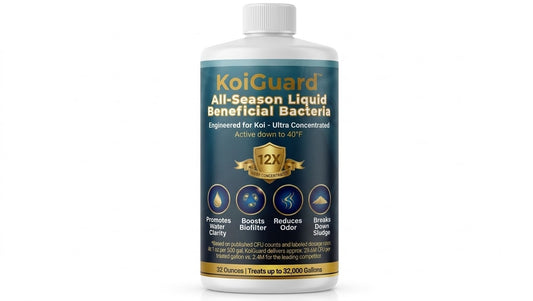
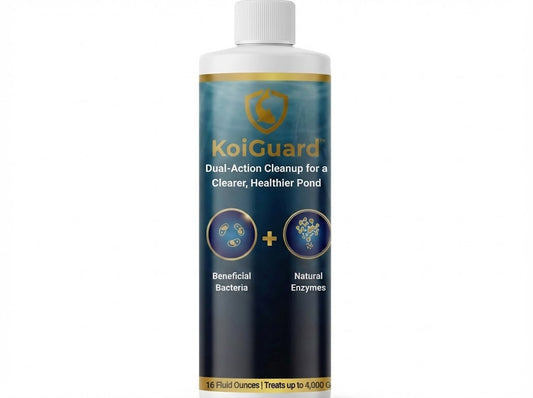
This is precisely why KoiGuard BeneZyme was formulated as a single 2-in-1 product combining both beneficial bacteria and enzymes. Rather than managing two separate dosing schedules, BeneZyme delivers both biological systems in one application — the bacteria to maintain the nitrogen cycle and the enzymes to break down organic waste. For most pond keepers, this simplifies the process without sacrificing effectiveness.
Dosing Considerations When Using Both
If you are using separate bacteria and enzyme products, timing matters. Apply beneficial bacteria directly to your biofilter area or near filter intakes where they can colonize media. Apply enzymes more broadly across the pond surface, where they can disperse throughout the water column.
One important note: if you use a UV clarifier, turn it off for 24 hours after applying beneficial bacteria. UV light kills microorganisms indiscriminately, and you want to give your bacteria time to attach to surfaces before exposing them to UV sterilization. Enzymes are not affected by UV since they are not living organisms.
For detailed dosing amounts based on your specific pond volume, the KoiGuard Pond Calculator can help you determine exact quantities.
Common Mistakes to Avoid
- Using only enzymes and expecting ammonia control. Enzymes have no effect on the nitrogen cycle. Test your water regularly.
- Using only bacteria and expecting sludge reduction. Bacteria colonize surfaces and process dissolved waste. They are not efficient sludge digesters.
- Overdosing enzymes in a pond with weak bacterial colonies. The rapid breakdown of organic matter can spike ammonia levels if bacteria cannot keep pace.
- Applying bacteria with the UV running. Always turn off UV clarifiers for 24 hours post-application.
- Cleaning the biofilter and skipping bacteria re-dosing. Anytime you disturb your filter media, follow up with a fresh bacteria dose.
The Bottom Line
Beneficial bacteria and pond enzymes are not competing products — they are complementary systems that address different parts of the waste breakdown process. Bacteria manage the nitrogen cycle by converting toxic ammonia and nitrite into safer nitrate. Enzymes break down solid organic waste like sludge, uneaten food, and plant debris into smaller compounds that bacteria and filtration can then handle.
For most koi ponds, using both delivers measurably better results than using either one alone. If simplicity matters to you, a combined formula handles both jobs in a single application. If your pond has specific challenges — a stubborn sludge problem or a nitrogen cycle that needs re-establishing — you can target the appropriate product for your situation.
The key takeaway: understand what each product does at the biological level, and your dosing decisions become straightforward. For more on the science behind pond biology, visit the KoiGuard Science page.